
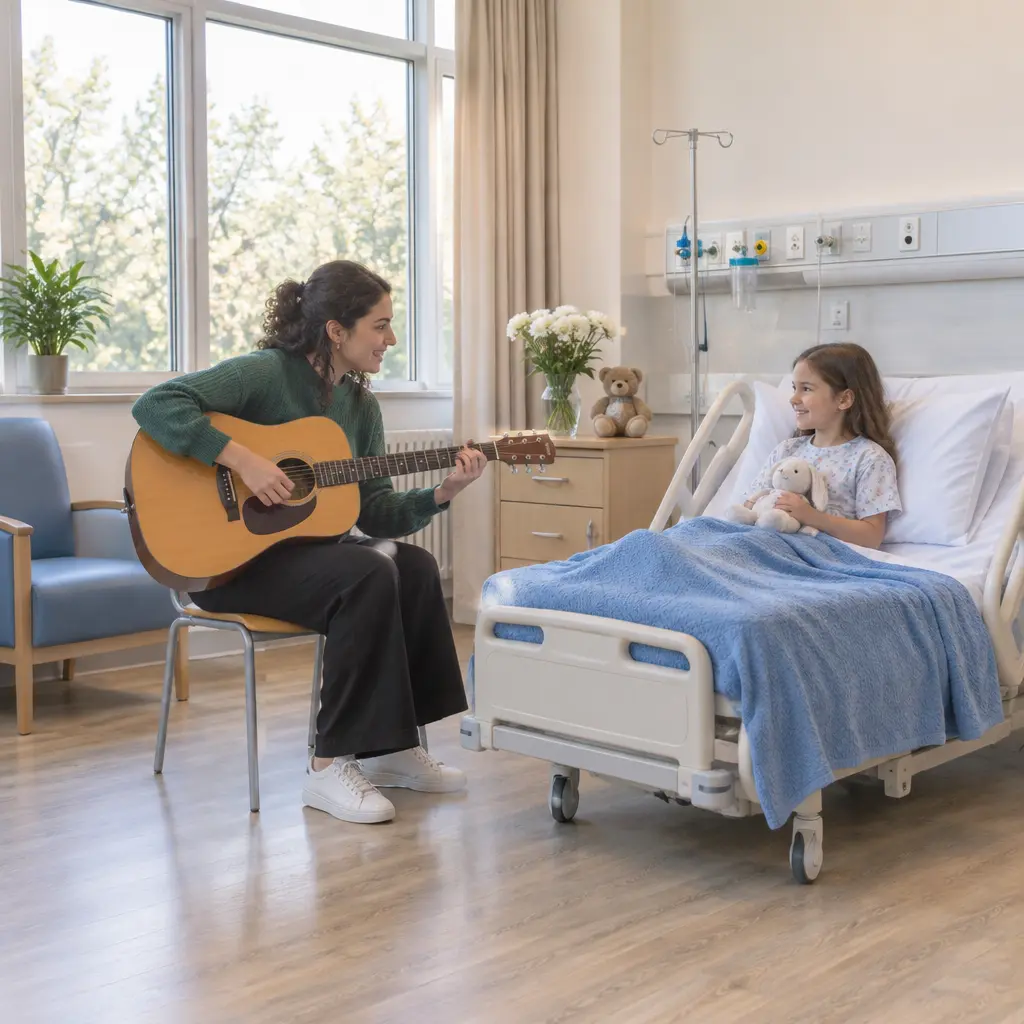
Music therapy is the clinical use of music by a trained professional to support health and well-being. For children receiving cancer treatment, it can offer a developmentally appropriate way to express fear, regain a sense of control, and cope with anxiety around procedures, hospitalization, and uncertainty. Research in pediatric oncology suggests music-based interventions can reduce children’s anxiety and distress in some settings, although results vary by intervention and study. This article explains how music therapy works, what children may do in sessions, what the evidence can—and cannot—show, and how families can find appropriate support.
Music therapy supports emotional processing during childhood cancer treatment
Cancer treatment can bring repeated needle procedures, unfamiliar environments, separation from everyday routines, and worries about pain or what comes next. The National Cancer Institute reports that cancer is diagnosed in approximately 400,000 children and adolescents aged 0–19 worldwide each year. In the United States, the National Cancer Institute estimates that about 9,550 children under age 15 will be diagnosed with cancer in 2024. These figures describe the scale of childhood cancer, not the number of children who experience anxiety; emotional responses differ from child to child.
Music therapy does not replace cancer care or guarantee that a child will feel calm. Instead, it gives children another channel for communication and coping, alongside medical, psychological, and family support. A board-certified music therapist may use singing, instruments, songwriting, listening, or music-assisted relaxation to help a child identify feelings, prepare for procedures, and experience choice and connection during a difficult period.
How music therapy addresses fear and anxiety in pediatric oncology
The American Music Therapy Association defines music therapy as the clinical and evidence-based use of music interventions to accomplish individualized goals within a therapeutic relationship, delivered by a credentialed professional. In pediatric oncology, goals may include emotional expression, coping with treatment-related stress, communication, relaxation, and participation in care. Music therapy is distinct from simply playing background music: the therapist assesses the child, selects or adapts activities, and evaluates responses in collaboration with the care team.
Fear and anxiety can overlap but are not identical. Fear is often a response to an immediate or recognizable threat, such as an injection. Anxiety may involve continuing worry about an upcoming procedure, results, or uncertainty. Music therapy can address both through active participation, emotional expression, preparation, and supportive listening. These approaches are sometimes called active music making, receptive music listening, songwriting, or music-assisted procedural support.
Emotional expression through music
Emotional expression means communicating feelings in a form that feels manageable to the child. A child who finds it difficult to describe fear may choose an instrument, create a rhythm, select a song, or write a lyric that represents what is happening. The therapist can help the child explore those choices without insisting on a particular interpretation. This matters because children’s understanding and verbal skills vary with age, development, fatigue, and treatment effects.
A 2016 systematic review and meta-analysis by Bradt and colleagues examined music interventions for pediatric patients with cancer. The authors found promising results for some outcomes, including anxiety and mood, while noting limitations in the number and quality of studies. The review supports music as a potentially useful complementary approach, not as a substitute for psychological assessment or treatment.
Choice, control, and coping skills
Choice is the opportunity to make small decisions within a situation largely controlled by treatment schedules and medical needs. A child might select a song, choose between a drum and a shaker, set the volume, or decide whether to sing or listen. These choices can support agency and engagement; they do not change the medical procedure or ensure that distress will disappear.
A therapist may also pair music with coping strategies such as paced breathing, imagery, or a predictable musical cue. For example, a child could practice a slow melody before a procedure and use it again during a difficult moment. The strategy should be personalized: some children prefer familiar songs, while others find sound overstimulating or want quiet.
Connection, routine, and family participation
Shared music can create a familiar point of connection between a child, family members, and hospital staff. A repeated song may help mark transitions, preserve a sense of routine, or provide a way for caregivers to participate without requiring the child to talk. When appropriate, therapists can help families use simple musical activities between sessions, while respecting the child’s preferences and energy level.
Music therapy should be adapted to infection-control requirements, fatigue, pain, sensory needs, and the child’s clinical condition. Hospital programs can use sanitized instruments, disposable items, or bedside activities. Participation is voluntary, and a child should be able to pause or stop.
Music therapy approaches used during cancer care
The approach depends on the child’s age, goals, treatment context, and preferences. A session may be active, with the child making music, or receptive, with the child listening and responding. In practice, therapists often combine approaches and coordinate with the oncology team so that activities fit the timing and demands of care.
Music during procedures
Procedural music therapy uses music to support coping before, during, or after medical procedures. The therapist may help a child choose music, create a song about the steps involved, or use rhythmic breathing and singing as a distraction. The goal is supportive coping, not to conceal information or persuade a child that a procedure will not hurt. Staff should still explain what is happening in an age-appropriate, honest way.
A 2015 systematic review by Klassen and colleagues evaluated complementary therapies for procedural pain and distress in children with cancer. It reported that music-based interventions showed potential benefits for some outcomes, but evidence quality and study methods varied. This is why results from an individual study should not be presented as a guaranteed effect for every child or every procedure.
Songwriting and therapeutic music making
Songwriting allows a child to create or adapt lyrics, melodies, or rhythms around personal experiences. It can help children communicate concerns, hopes, anger, or humor in a form they control. Therapeutic music making may include improvisation on instruments, call-and-response, or composing a shared piece with a therapist. These activities are not tests of musical ability; the process and the child’s goals matter more than performance.
Receptive listening and relaxation
Receptive music therapy involves listening to music selected with the therapist, sometimes alongside guided imagery or relaxation. The therapist may invite the child to notice how the music affects breathing, tension, or mood. Because responses to music are personal, familiar music is not automatically calming: a song may bring up difficult memories, and loud or complex sound may increase discomfort for some children.
A Cochrane review by Bradt and colleagues on music interventions for mechanically ventilated patients found that music may reduce anxiety in some adult intensive-care contexts, but those findings should not be directly generalized to children undergoing cancer treatment. Pediatric oncology decisions should rely on evidence relevant to children and on the individual child’s response.
What research says about music therapy and childhood cancer anxiety
Research supports music therapy as a promising complementary service, but the evidence base remains limited by small studies, varied interventions, and different ways of measuring anxiety and distress. Studies may examine a single procedure, a short inpatient period, or a specific age group, so their results do not necessarily apply to every treatment setting. Anxiety can also change with pain, medication, diagnosis, family circumstances, and the phase of treatment.
The Society for Integrative Oncology and the American Society of Clinical Oncology have issued guidance on integrative therapies for anxiety and depression in adults with cancer. That guidance is not pediatric-specific and should not be treated as proof of effectiveness for children. For pediatric care, families and clinicians should consider child-focused evidence and consult the oncology team.
When assessing a program, useful questions include whether a credentialed music therapist leads the sessions, what goals are set, how the child’s response is monitored, and whether the service coordinates with psychosocial oncology. Anxiety that is severe, persistent, or interfering with treatment deserves assessment by qualified mental-health professionals. Music therapy can complement that care but should not delay it.
Finding safe, child-centered music therapy
Families can ask the child’s oncology team, child-life department, or psychosocial oncology service whether music therapy is available. In the United States, the Music Therapist–Board Certified credential, abbreviated MT-BC, is awarded through the Certification Board for Music Therapists. Credentialing and professional titles differ by country, so families should check local standards and ask about the therapist’s pediatric and medical experience.
A suitable service should explain its goals, respect the child’s right to decline, and adapt to treatment precautions. Families can ask how sessions are adjusted for fatigue or sensory sensitivities, whether instruments are cleaned according to hospital policy, and how the therapist communicates with the care team. If a child becomes more distressed, the activity should be changed or stopped, and the team should be informed.
Conclusion: Music therapy offers a supportive route through treatment-related fear
Music therapy uses a professional therapeutic relationship and individualized musical activities to support emotional expression, coping, choice, and connection during childhood cancer treatment. Procedural music support, songwriting, active music making, and receptive listening can all be adapted to a child’s needs. Research is encouraging but not definitive, so music therapy should be viewed as a complement to—not a replacement for—medical care and evidence-based mental-health support.
Families can ask their oncology team about a credentialed music therapist and discuss whether the child would welcome this option. Further reading from the National Cancer Institute, the American Music Therapy Association, and pediatric oncology research reviews can help families make informed, individualized decisions.
Sources: National Cancer Institute, Childhood Cancers, https://www.cancer.gov/types/childhood-cancers; National Cancer Institute, Cancer in Children and Adolescents, https://www.cancer.gov/types/childhood-cancers/child-adolescent-cancers-fact-sheet; American Music Therapy Association, What Is Music Therapy?, https://www.musictherapy.org/about/musictherapy/; Bradt, J., et al., “Music interventions for improving psychological and physical outcomes in cancer patients,” Cochrane Database of Systematic Reviews, 2016, https://doi.org/10.1002/14651858.CD006911.pub3; Klassen, J. A., et al., “Music for pain and anxiety in children undergoing medical procedures: a systematic review of randomized controlled trials,” Ambulatory Pediatrics, 2008, https://doi.org/10.1016/j.ambp.2008.04.005; Klassen, J. A., et al., “Complementary and alternative medicine therapies for the management of pain and stress for children undergoing medical procedures,” Cochrane Database of Systematic Reviews, 2015, https://doi.org/10.1002/14651858.CD005179.pub4; Certification Board for Music Therapists, Board Certification, https://www.cbmt.org/.