
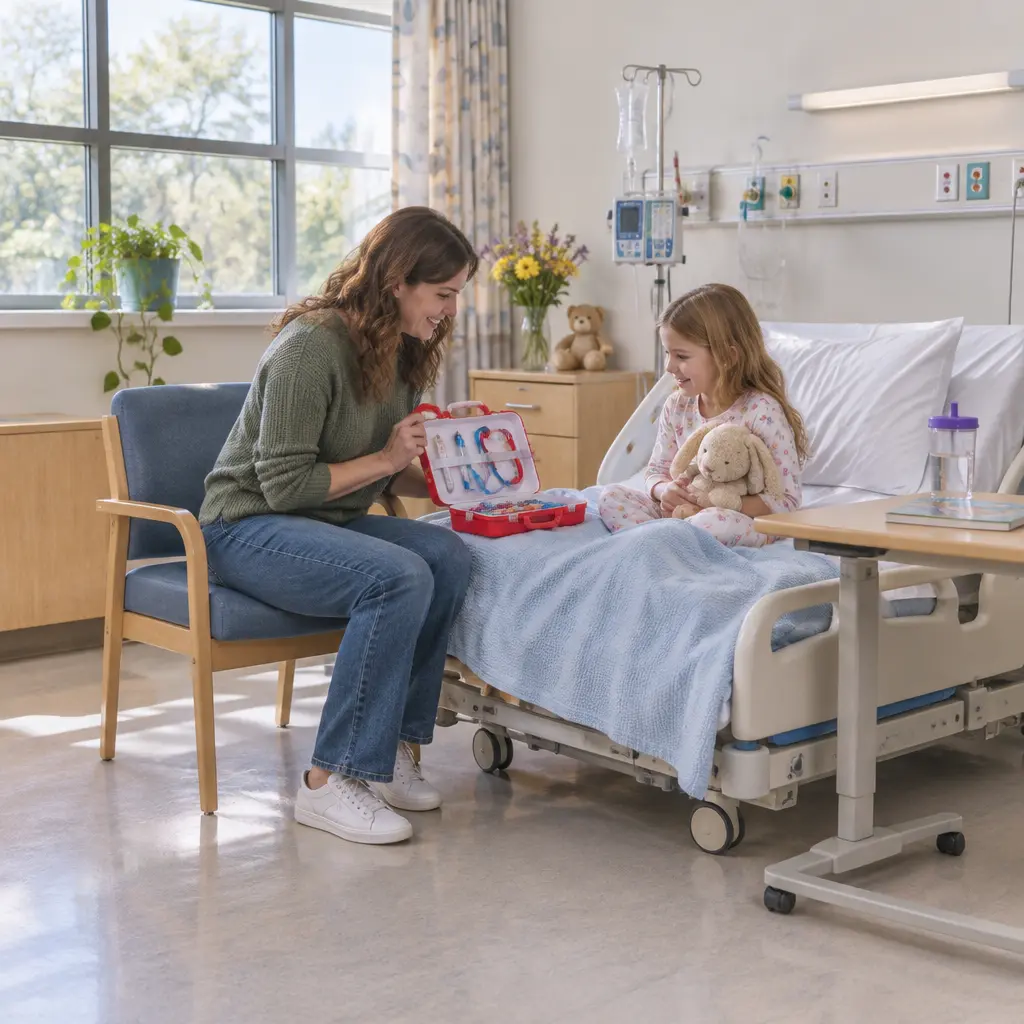
A frightening hospital stay can feel more manageable for a young child when adults explain what is happening in age-appropriate language, preserve familiar routines, invite safe choices, and use play and caregiver support to reduce uncertainty. The World Health Organization estimates that up to 1 in 2 children experience significant fear of medical procedures, while pediatric-care guidance from the American Academy of Pediatrics emphasizes family-centered communication and developmentally appropriate preparation. Together, these approaches help children understand what to expect, feel supported during procedures, and regain a sense of control.
Reducing Fear Through Child-Centered Hospital Preparation
Child-centered hospital preparation is the process of helping a child understand and cope with illness, unfamiliar surroundings, and medical care in ways suited to the child’s age, communication skills, and individual needs. The Institute for Patient- and Family-Centered Care describes family-centered care as a partnership among patients, families, and health professionals, built on respect, information sharing, participation, and collaboration. In practice, preparation can include a simple explanation before a procedure, a caregiver’s presence when possible, medical play, comfort objects, and honest answers to questions.
The need is substantial: the World Health Organization reports that an estimated 1 in 2 children experience significant fear of medical procedures. Fear may arise from pain, separation, loss of control, or not knowing what will happen. These concerns can affect cooperation and the child’s experience of care, so reducing distress is not simply a matter of making a hospital visit pleasant; it is part of supporting safe, respectful pediatric care.
Developmentally Appropriate Explanations
Developmentally appropriate communication means describing an event in terms a child can understand without making promises that may not be true. The American Academy of Pediatrics advises clinicians to communicate with children in ways that reflect their developmental level and to include families in care. For a preschooler, “The nurse will put a small straw in your hand so medicine can go into your body” is generally more concrete than a detailed explanation of an intravenous catheter.
Tell children what they may see, hear, and feel, and explain what will happen afterward. If a procedure may hurt, acknowledge that honestly and explain how the team will help. Avoid phrases such as “This won’t hurt” when discomfort is possible; broken promises can undermine trust. Offer information shortly before it is useful, then check understanding with a question such as, “What do you think will happen next?”
Predictability, Choice, and a Sense of Control
Predictability is knowing what is likely to happen and in what order; meaningful choice gives a child control over safe, manageable details. These approaches do not mean children decide whether essential treatment occurs. Instead, they can choose which arm to use when clinically appropriate, whether to sit on a caregiver’s lap or a chair, or which story to hear during a procedure.
The Centers for Disease Control and Prevention recommends preparing children for stressful events with clear, age-appropriate information and reassuring support. A short sequence—“First we will clean your skin, then you may feel a quick pinch, and afterward we will put on a bandage”—can replace uncertainty with an understandable plan. Staff should explain when a choice is real; offering an option that the child cannot actually select can make the experience feel less trustworthy.
Once children know what to expect, the next step is to make the hospital environment feel more familiar and to support the people who help them feel secure.
Using Familiar Relationships, Play, and Comfort to Ease Hospital Anxiety
Emotional support in hospital care includes caregiver involvement, therapeutic play, and comfort measures that help a child manage distress. The American Academy of Pediatrics identifies family-centered care as an important foundation of pediatric practice. A familiar adult can interpret a child’s cues, offer reassurance, and help maintain continuity during a disruptive experience.
Caregiver Presence and Family Partnership
Caregiver presence means involving a parent or another trusted adult in ways that are safe and practical for the child’s care. Families can share what comforts the child, what language the child understands, and what tends to increase fear. They may also help keep a familiar bedtime routine, bring a favorite blanket, or hold the child during a procedure when the clinical team agrees.
Hospital policies and clinical circumstances differ, so caregiver participation should be discussed with the care team rather than assumed. Staff can explain where a caregiver may stand, what support is helpful, and when a procedure requires additional space. This partnership can reduce mixed messages and help the child experience adults as a coordinated, dependable team.
Therapeutic Play and Preparation Programs
Therapeutic play uses play to help children express feelings, rehearse events, and understand medical experiences. A child-life specialist may use a doll, toy medical equipment, drawings, or role-play to show what a test or treatment involves. The Association of Child Life Professionals describes child-life practice as supporting children and families through illness, injury, and healthcare experiences using developmentally appropriate preparation, play, and coping strategies.
For example, a child might practice placing a bandage on a doll before receiving one, or use a toy mask to learn how anesthesia equipment may look. Play does not need to persuade a child that treatment is enjoyable; its purpose is to give the child a safe way to ask questions and rehearse coping. Availability of child-life services varies by hospital, but caregivers and staff can often adapt simple preparation activities when specialists are not available.
Comfort Measures During Procedures
Comfort measures are practical supports used to reduce distress during examinations and procedures. Depending on the child’s age, medical needs, and the procedure, these can include distraction, breathing games, music, a video, a comfort object, a caregiver’s voice, or prescribed pain-relief measures. The American Academy of Pediatrics emphasizes that pain in children should be recognized and managed rather than dismissed.
A comfort plan should match the procedure and the individual child. A child who enjoys stories might listen to a familiar book; another might prefer to look away and squeeze a caregiver’s hand. Teams should explain which measures are appropriate and continue to check the child’s comfort instead of relying on a single technique for every situation.
These supportive practices work best when they are combined with practical steps before admission and adapted to the child’s age, history, and particular worries.
Preparing for Admission and Responding to Different Needs
Hospital preparation is an ongoing conversation, not a single explanation at the hospital door. Families can ask the care team what is known about the admission, which events may be difficult, and what options exist for comfort and communication. Because children vary in temperament, developmental stage, prior medical experiences, and sensory needs, preparation should be individualized.
Before the Hospital Visit
Before admission, explain the reason for the visit using simple, accurate language and give the child a chance to ask questions. If the hospital offers a tour, preparation video, or child-life consultation, ask whether it is appropriate. Pack familiar items where permitted, such as a favorite toy, pajamas, or a family photograph, and bring a list of the child’s usual routines, communication preferences, medications, and concerns.
Do not overwhelm children with information far ahead of time if it is likely to fuel prolonged worry. The right timing depends on the child and the situation. For an unexpected admission, caregivers can still offer a brief, calm explanation of what is happening now and what the next step will be.
Adapting Support by Age and Communication Style
Children do not all understand or express fear in the same way. Younger children may need concrete explanations and repeated reassurance; school-age children may ask detailed questions about how a procedure works. Adolescents may want privacy, direct information, and a meaningful role in decisions. These are broad patterns, not rules: caregivers and clinicians should follow the individual child’s questions and cues.
For children with autism, developmental disabilities, language differences, or sensory sensitivities, ask the family what communication methods and accommodations work best. A visual schedule, interpreter, reduced noise, extra time, or advance notice before touch may help. The U.S. Department of Health and Human Services’ guidance on effective communication underscores the importance of providing appropriate communication assistance for people with disabilities and limited English proficiency.
Recognizing Distress and Asking for Help
Children may show fear through crying, silence, irritability, clinginess, sleep disruption, or resistance to care. These behaviors are signals to explore what the child needs, not evidence that the child is being difficult. A caregiver can tell the nurse or doctor what has changed and ask whether pain, fatigue, confusion, or a particular fear might be contributing.
If distress remains intense, ask whether the hospital has a child-life specialist, a pediatric pain service, a social worker, or other support. The care team can assess the situation and recommend options suited to the child’s treatment. Families should seek urgent clinical guidance for concerns about pain, medication effects, or a sudden change in the child’s condition.
Conclusion: Small Changes Can Make Hospital Care Feel Safer
Developmentally appropriate explanations, predictable steps, safe choices, caregiver partnership, therapeutic play, and individualized comfort measures can make a hospital stay less frightening for young children. The World Health Organization’s estimate that up to 1 in 2 children experience significant fear of medical procedures highlights why preparation and emotional support matter. These practices cannot remove every worry or guarantee an easy experience, but they can help children feel heard, supported, and better able to cope.
Before a hospital visit, ask the care team how to prepare your child, what comfort options are available, and whether child-life or communication support can help. During the stay, share what your child is feeling and what usually brings comfort. A more reassuring experience begins with a simple partnership: explain honestly, listen closely, and help the child know what comes next.
Sources: World Health Organization, “Reducing pain and distress in children undergoing medical procedures,” https://www.who.int/; American Academy of Pediatrics, “Patient- and Family-Centered Care and the Pediatrician’s Role,” https://publications.aap.org/pediatrics/article/129/2/394/31637/Patient-and-Family-Centered-Care-and-the; Institute for Patient- and Family-Centered Care, “Patient- and Family-Centered Care,” https://www.ipfcc.org/about/pfcc.html; Centers for Disease Control and Prevention, “Helping Children Cope During and After a Disaster,” https://www.cdc.gov/childrenindisasters/; Association of Child Life Professionals, “About Child Life,” https://www.childlife.org/about-child-life; American Academy of Pediatrics, “The Assessment and Management of Acute Pain in Infants, Children, Adolescents, and Young Adults,” https://publications.aap.org/pediatrics/article/137/2/e20154271/52808/The-Assessment-and-Management-of-Acute-Pain-in; U.S. Department of Health and Human Services, “Guidance to Federal Financial Assistance Recipients Regarding Title VI Prohibition Against National Origin Discrimination Affecting Limited English Proficient Persons,” https://www.hhs.gov/civil-rights/for-individuals/section-1557/translated-resources/index.html.