
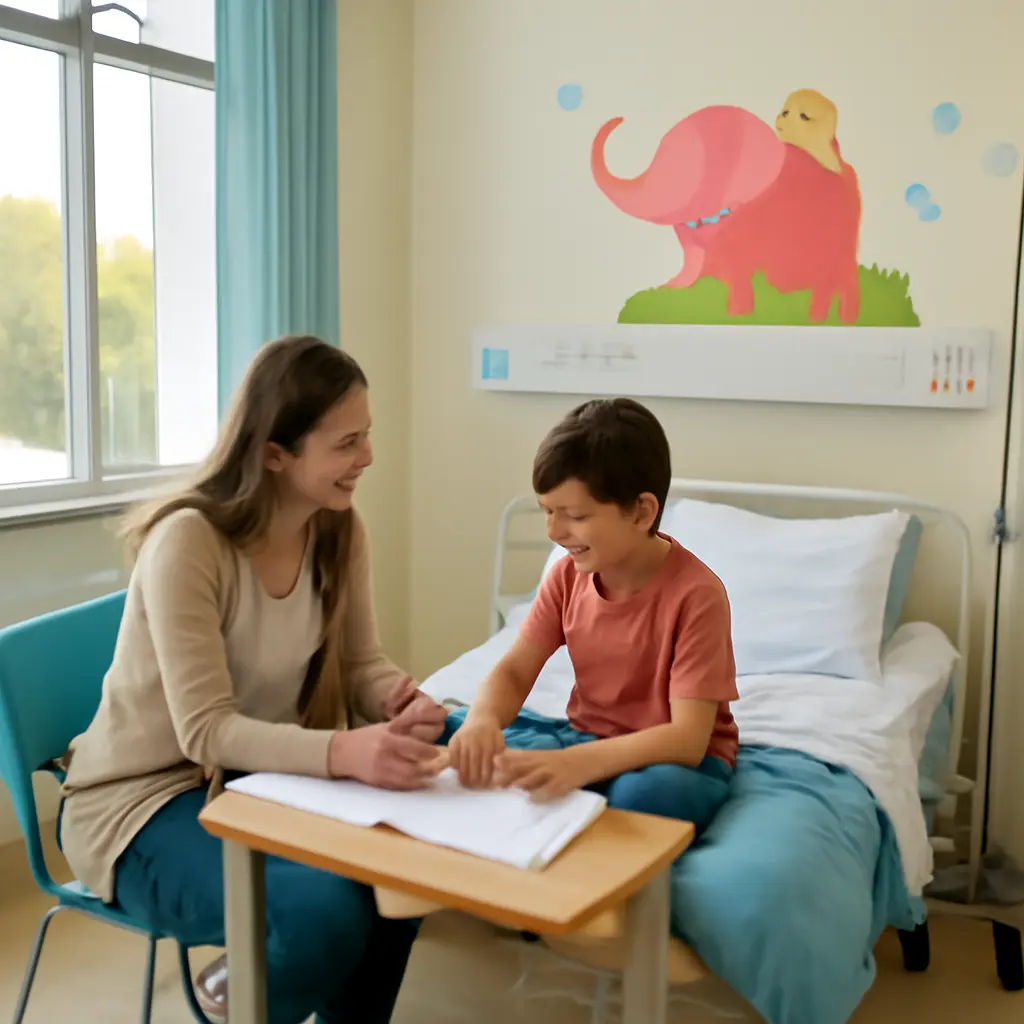
A hospital stay that lasts weeks or months can disrupt a child’s learning, routines, friendships, and sense of control. Hospitals support children on extended stays in ways that go beyond medical treatment: hospital schools help them keep learning, play and creative programs provide normalcy and emotional expression, family-centered care keeps caregivers involved, child-life specialists prepare children for procedures, and peer or community connections reduce isolation. These services matter because prolonged hospitalization can affect a child’s development and well-being as well as physical health.
Hospital schools protect learning during extended stays
Hospital-based education is instruction arranged for students whose health keeps them from attending their usual school. The U.S. Department of Education explains that eligible children with disabilities may receive special education and related services in a hospital or at home under the Individuals with Disabilities Education Act (IDEA), when appropriate. Hospital schools can coordinate with a child’s regular school, adapt lessons to treatment schedules, and help ease the transition back to class.
Bedside teaching and school coordination
Bedside teaching brings lessons to a child’s room when they cannot attend a classroom because of infection precautions, fatigue, pain, or limited mobility. Teachers may adapt assignments, communicate with the child’s school, and help preserve familiar academic goals. The National Association of Child Life Professionals and hospital education programs describe this coordination as one way to reduce the disruption illness can cause to a student’s school identity and routine. The exact service varies by hospital, and not every facility has a dedicated teacher.
A bridge back to the classroom
The educational support may continue after discharge. With family consent, hospital staff can share information about a student’s functional needs and help coordinate a gradual return, such as shortened days, make-up work, or temporary accommodations. IDEA requires public schools to provide eligible students with a free appropriate public education, including services in settings such as hospitals when required by the child’s individualized education program. This connection can help prevent a medical interruption from becoming a longer educational setback.
Play and creative programs support coping
Therapeutic play is purposeful play used to support a child’s coping, development, and communication during care. It can include games, art, music, storytelling, or activities that let children express feelings and regain a sense of choice. The American Academy of Pediatrics recognizes play as important to children’s development and notes that play in health-care settings can help children cope with illness and hospitalization.
Playrooms, bedside activities, and creative expression
A playroom can offer a change of scenery and opportunities for social interaction, while bedside kits bring activities to children who are isolated or too unwell to leave their rooms. Art and music can give children a way to express fear, boredom, or frustration when talking feels difficult. Programs are adjusted for age, energy, safety, and infection-control needs; for example, a child receiving isolation precautions may receive individual activities instead of joining a group.
Normal routines in an unusual place
Scheduled story times, celebrations, and recreational activities can restore pieces of everyday childhood. These programs do not replace clinical mental-health care, but they can make the hospital environment feel less defined by tests and treatment. The Association of Child Life Professionals describes play as a central tool for helping children understand and cope with health-care experiences. Families can ask what activities are available and whether they can be adapted to a child’s treatment plan.
Family-centered care makes caregivers part of the team
Family-centered care is an approach that treats families as partners in a child’s health care, recognizing their knowledge of the child and supporting participation in decisions. The Institute for Patient- and Family-Centered Care identifies dignity and respect, information sharing, participation, and collaboration as core principles. For children on extended stays, this approach can help preserve familiar routines and ensure that care plans reflect the child’s needs and family circumstances.
Family participation and shared decisions
Caregivers may join bedside rounds, help explain a child’s communication cues, and contribute to decisions about daily routines and treatment. The American Academy of Pediatrics’ policy on family-centered care supports partnering with families in pediatric settings. Participation does not mean parents must take on clinical responsibilities; rather, staff and families share information and clarify roles so caregivers can support their child without being left to manage care alone.
Practical support for the whole family
Extended stays can also place pressure on siblings, work schedules, transportation, and household finances. Depending on the hospital, social workers may connect families with lodging resources, financial counseling, interpreters, or community services. Ronald McDonald House Charities, for example, provides accommodation near participating hospitals for families of seriously ill children. Availability and eligibility differ by location, so families can ask a hospital social worker or care coordinator about local options.
Child-life specialists prepare children for treatment
Child life is a health-care specialty focused on children’s development and their psychosocial responses to illness, injury, and medical experiences. The Association of Child Life Professionals says certified child life specialists use developmentally appropriate preparation, play, and coping support to help children and families navigate care. On a long admission, their involvement may recur as new procedures or changes in treatment arise.
Procedure preparation and coping strategies
Before a procedure, a specialist may explain what will happen using language, dolls, pictures, or medical play suited to the child’s age and understanding. They can help children practice coping strategies such as breathing, distraction, or choosing a comfort item. Preparation is tailored to the child and coordinated with the clinical team; it is not a guarantee that a procedure will be painless or anxiety-free, but it can give the child clearer expectations and ways to participate.
Support for siblings and changing needs
Some child-life programs also help siblings understand a brother’s or sister’s hospitalization through age-appropriate explanations and visits when appropriate. This can reduce confusion and help siblings remain connected to the hospitalized child. The American Academy of Pediatrics has emphasized that children’s understanding of illness changes with development, which is why explanations should be matched to age and individual needs. Families can ask whether the hospital offers sibling support or preparation for a child returning home with new care needs.
Peer and community connections reduce isolation
Social connection is another form of support: it helps children maintain relationships and a sense of belonging while away from home. Hospitals may facilitate visits, video calls, group activities, or contact with school and community organizations, subject to the child’s health, privacy, and infection-control requirements. These connections can be particularly meaningful when a stay separates a child from classmates and friends for a long period.
Keeping in touch with friends and classmates
With the child’s and family’s agreement, a hospital or school may help arrange video greetings, shared class projects, or messages from classmates. Digital contact can preserve relationships when in-person visits are not possible, although it should be paced around treatment and the child’s energy. Hospitals should also protect patient confidentiality: families and schools should agree on what health information, if any, is shared.
Community programs and special experiences
Some hospitals work with volunteers and nonprofit organizations to offer bedside visits, performances, celebrations, or activities connected to a child’s interests. These programs can create positive experiences without asking a child to leave the care environment. Access varies considerably, and safety rules may limit group events or outside visitors. Families can ask the care team which programs are available and whether a child’s medical precautions affect participation.
Conclusion: support extends beyond the treatment plan
Hospital schools, therapeutic play, family-centered care, child-life services, and peer connections show how hospitals can support children’s development and emotional lives alongside medical treatment. These services may help preserve learning, offer coping tools, keep families involved, and reduce the isolation of a prolonged admission. What is available differs by hospital, so caregivers can ask the care team about education, child-life, social-work, recreation, and family-support resources early in the stay. For further guidance, consult the hospital’s patient and family services office and the organizations listed below.
Sources: U.S. Department of Education, Individuals with Disabilities Education Act (IDEA), https://sites.ed.gov/idea/; American Academy of Pediatrics, “The Importance of Play in Promoting Healthy Child Development and Maintaining Strong Parent-Child Bonds,” https://publications.aap.org/pediatrics/article/119/1/182/70699/The-Importance-of-Play-in-Promoting-Healthy-Child; Association of Child Life Professionals, “About Child Life,” https://www.childlife.org/the-child-life-profession; Institute for Patient- and Family-Centered Care, “Core Concepts of Patient- and Family-Centered Care,” https://www.ipfcc.org/about/pfcc.html; Ronald McDonald House Charities, “Our Programs,” https://rmhc.org/our-programs; American Academy of Pediatrics, “Patient- and Family-Centered Care and the Pediatrician’s Role,” https://publications.aap.org/pediatrics/article/129/2/394/31721/Patient-and-Family-Centered-Care-and-the-Pediatrician’s-Role