
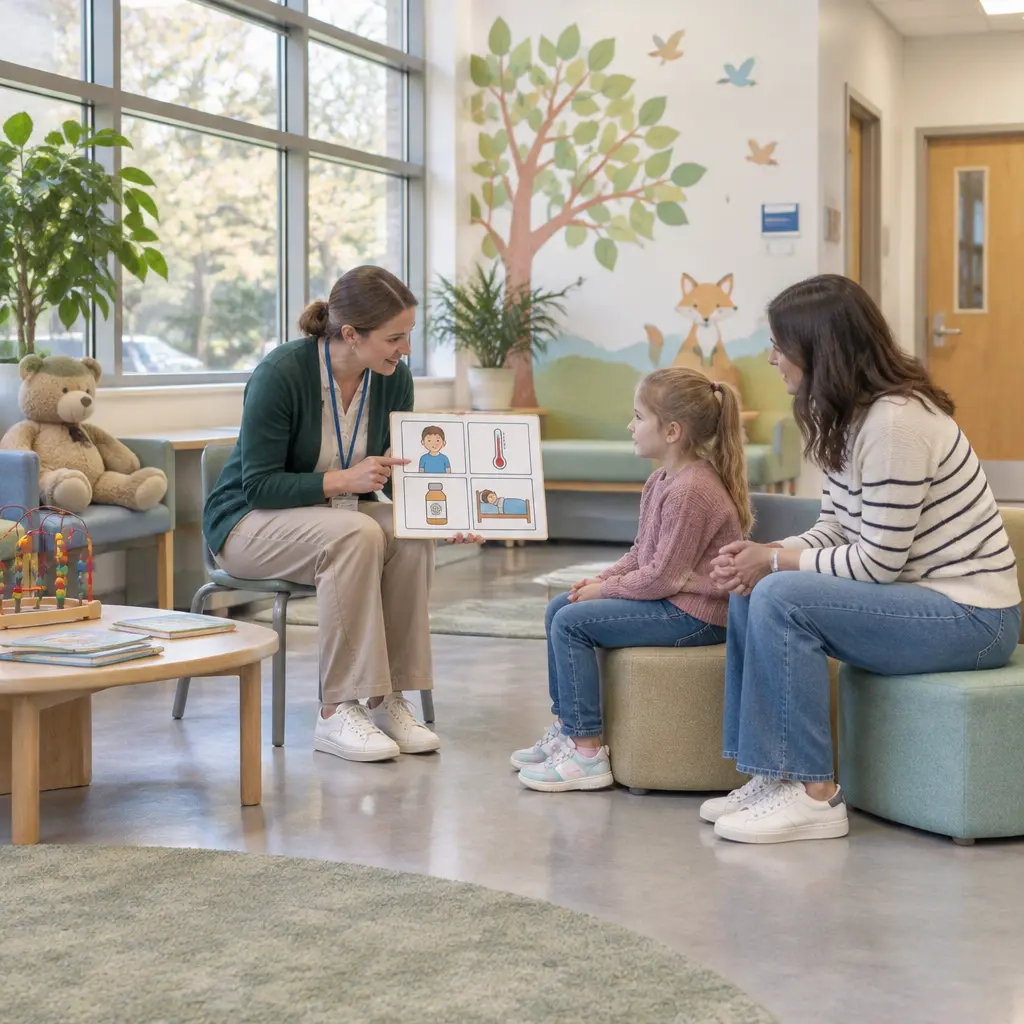
A child-friendly hospital is a healthcare setting designed to meet children’s medical, developmental, and emotional needs—not simply a smaller version of an adult hospital. Making hospitals feel less intimidating can involve play, family participation, clear age-appropriate explanations, comforting spaces, and care practices that reduce pain and uncertainty. These approaches matter because, according to the Centers for Disease Control and Prevention, about 1 in 6 U.S. children aged 3–17 had a diagnosed developmental disability in 2009–2017, underscoring the importance of adapting care to different needs. Research and pediatric guidance support a practical message: hospitals cannot remove the stress of illness, but they can make the experience safer, more understandable, and more humane.
Child-Friendly Hospital Design and Experience
Child-friendly hospital design is the planned use of spaces, services, communication, and routines to help children feel safe and involved while receiving care. The World Health Organization’s standards for quality care for children and young adolescents emphasize care that is safe, effective, child-centred, and responsive to children’s needs and rights. In practice, the concept includes several related approaches: supportive physical environments, therapeutic play, family-centred care, developmentally appropriate communication, and careful attention to pain and sensory stress.
Comforting, Understandable Spaces
A child-friendly physical environment uses scale, light, color, wayfinding, and familiar objects to make care spaces less confusing and threatening. This does not mean making every clinical area look like a playground; it means balancing infection control and safety with warmth, privacy, and clear cues about where to go and what happens next. Signs with simple words and pictures, welcoming waiting areas, access to daylight, and places for a caregiver to stay can reduce avoidable confusion.
The design principle is especially important for children who are very young, have disabilities, or find unfamiliar sounds and sensations overwhelming. The American Academy of Pediatrics has noted that sensory features such as noise, bright lights, and unpredictable routines can create barriers for children with autism and other developmental differences. Hospitals can offer quieter waiting options, explain equipment before use, and provide individualized sensory supports where feasible. A visual guide or simple sequence chart can show the steps of a visit, from check-in to going home.
Therapeutic Play and Preparation
Therapeutic play is the purposeful use of play, toys, and creative activities to help children express feelings, understand treatment, and practice coping. It includes medical play with safe equipment, preparation for procedures, distraction during painful or frightening moments, and ordinary play that supports normal development during hospitalization. A trained child life specialist may use a doll, model, or demonstration to explain what a child will see and feel, then help the child rehearse coping strategies.
The Association of Child Life Professionals describes child life specialists as professionals who support children and families facing stressful healthcare and other life experiences. Play is not a substitute for medical treatment, but it can give children an active role and make unfamiliar events more predictable. For example, a child preparing for an imaging scan might first see a picture sequence, listen to the machine’s sounds, and practice lying still with a toy. The approach should be matched to the child’s age, communication style, culture, and preferences rather than applied as a one-size-fits-all activity.
Family-Centred Care
Family-centred care treats parents and caregivers as partners in a child’s care while recognizing the child as a participant whose views should be heard in an age-appropriate way. Care teams can invite caregivers to share routines, comfort strategies, communication needs, and signs that a child is becoming distressed. When clinically appropriate, families may stay with children during procedures or recovery and help with familiar activities such as feeding, soothing, or bedtime routines.
The Institute for Patient- and Family-Centered Care identifies dignity and respect, information sharing, participation, and collaboration as core principles. These practices can make care more coherent: a caregiver may know which words calm a child, while a child may prefer a choice about which arm is used for a blood-pressure cuff. Participation should not become pressure on families to provide clinical care or make decisions without support. Staff remain responsible for explaining options, answering questions, and respecting family circumstances.
Communication and Care That Reduce Fear
A welcoming environment works best when clinical interactions are also predictable and respectful. Children may interpret unfamiliar equipment, separation, or unexplained procedures as threats. Clear communication, appropriate choices, and planned pain relief connect the physical environment to the child’s immediate experience of care.
Age-Appropriate Explanations and Choices
Age-appropriate communication explains what is happening in words a child can understand, without promising that a procedure will not hurt when discomfort is possible. Clinicians can describe sensations honestly, use pictures or demonstrations, pause for questions, and check understanding. Offering meaningful choices—such as choosing a distraction video or deciding whether a caregiver holds a hand—can help a child feel some control while keeping medically necessary decisions with the care team.
The National Institute of Child Health and Human Development reports that children’s language, reasoning, and ability to understand illness change as they grow. A preschooler may benefit from a short explanation immediately before an event, while an adolescent may want more detailed information and a private opportunity to ask questions. Children with communication differences may need augmentative communication, extra processing time, or familiar communication tools. Staff should address the child directly when possible, not discuss the child as though they are absent.
Pain Prevention and Coping Support
Pain-aware pediatric care combines appropriate medication with non-drug strategies such as positioning, comfort holding, breathing, distraction, and preparation. Pain should be assessed using an age- and ability-appropriate tool, then reassessed after interventions. For infants and children who cannot describe pain verbally, clinicians can use validated behavioral or observational measures rather than assuming that silence means comfort.
The World Health Organization’s guidelines on the management of chronic pain in children emphasize assessment and a child- and family-centred approach. For short procedures, the Centers for Disease Control and Prevention’s guidance on vaccination pain management includes strategies such as holding infants and using distraction for older children. A hospital can also reduce distress by clustering care when appropriate, avoiding unnecessary waiting, and explaining delays. These steps do not guarantee that a child will feel no fear or pain; they give staff a structured way to prevent avoidable suffering and respond when it occurs.
Inclusive Care for Different Developmental and Sensory Needs
Inclusive pediatric care adapts the visit to a child’s disability, neurodevelopment, language, culture, and sensory preferences. Helpful adjustments may include a quieter room, a predictable schedule, interpreter services, accessible equipment, visual supports, or a longer appointment. The best adjustment is individualized: one child may find music calming, while another may find it distracting or painful.
The CDC’s estimate that approximately 1 in 6 children aged 3–17 had a diagnosed developmental disability during 2009–2017 illustrates why flexible care is not a niche concern. The figure covers a broad group of conditions and does not describe every child’s needs, so hospitals should ask families rather than infer preferences from a diagnosis. A practical approach is to record effective accommodations in the care plan and share them with relevant staff, while protecting the child’s privacy.
Putting Child-Friendly Care into Practice
Hospitals can make these ideas operational by combining design improvements with staff training, family feedback, and measurable quality goals. A colorful waiting room alone is not enough if children are left uninformed, pain is overlooked, or caregivers cannot participate. The strongest programs treat the child’s emotional experience as part of care quality, alongside safety and clinical outcomes.
A Practical Hospital Checklist
- Ask each child and caregiver what helps, what causes distress, and how the child communicates.
- Explain procedures in plain, honest language and offer preparation suited to the child’s age and needs.
- Use validated pain and distress assessment methods, and document whether support strategies worked.
- Provide appropriate play, distraction, and child life support, especially around unfamiliar procedures.
- Make care spaces easier to navigate, with clear signs, accessible facilities, and options to reduce sensory overload.
- Invite caregivers to participate while preserving the child’s voice, privacy, and developmentally appropriate independence.
- Collect feedback from children and families and use it to improve routines, not just décor.
Measuring Whether the Experience Improves
Hospitals can assess progress through child and caregiver experience surveys, reports of pain and distress, use of interpretation and accessibility supports, and feedback about communication and participation. Measures should be interpreted alongside clinical safety and outcomes; a high satisfaction score alone cannot establish that care is effective. Results can also be reviewed across age groups and disability or language needs to identify whether improvements are reaching children who face additional barriers.
A useful visual for a hospital improvement report would be a simple before-and-after chart showing family-reported understanding, children’s reported fear or comfort, and documented use of pain-prevention strategies. The chart should state how responses were collected and how many families participated. A real-world example of the broader approach is the presence of child life services in pediatric hospitals, where preparation, play, and coping support are integrated into care rather than treated as decoration or entertainment.
Conclusion
Making a hospital feel less like a hospital for children means combining child-friendly spaces with therapeutic play, family-centred care, developmentally appropriate communication, pain prevention, and inclusive accommodations. These connected practices can make care more understandable and supportive without compromising clinical standards. Given the range of children’s developmental and sensory needs, hospitals should ask each child and family what works, train staff to respond, and measure whether changes improve the experience. Healthcare leaders, clinicians, and families can use the guidance from the World Health Organization, CDC, and pediatric support organizations to make children’s voices and comfort a routine part of care.
Sources: World Health Organization, Standards for improving the quality of care for children and young adolescents in health facilities, https://www.who.int/publications/i/item/9789241565554; Centers for Disease Control and Prevention, Developmental Disabilities Among Children Aged 3–17 Years in the United States: 2009–2017, https://www.cdc.gov/nchs/products/databriefs/db291.htm; American Academy of Pediatrics, Health Care for Children and Adolescents With Autism Spectrum Disorder, https://publications.aap.org/pediatrics/article/145/1/e20193447/36917/Health-Care-for-Children-and-Adolescents-With; Association of Child Life Professionals, The Child Life Profession, https://www.childlife.org/the-child-life-profession; Institute for Patient- and Family-Centered Care, Patient- and Family-Centered Care, https://www.ipfcc.org/about/pfcc.html; National Institute of Child Health and Human Development, Child Development and Behavior, https://www.nichd.nih.gov/health/topics/child-development; World Health Organization, Guidelines on the management of chronic pain in children, https://www.who.int/publications/i/item/9789240017870; Centers for Disease Control and Prevention, Vaccine Administration: Before Giving Vaccine, https://www.cdc.gov/vaccines/hcp/administration/before.html.